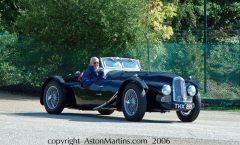
In 1948, the Two Litre Sports (retrospectively known as the DB1) was introduced, based on the Atom Prototype and powered by Claude Hill’s 4 cylinder engine but it did not prove popular and only 16 examples were built. Whilst the 2 litre DB1 is sometimes considered overweight and underpowered compared to both pre-war and post-war Aston Martins, this may be a little unfair as in part this could be to due the low octane pool petrol in the UK during the immediate post war period.
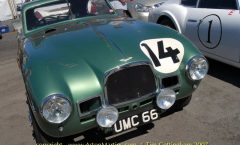
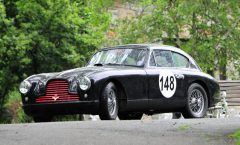
The DB1 was superseded by the DB2 complete with the 6 cylinder Willie Watson designed engine (under the supervision of W.O.Bentley) and acquired by David Brown with the Lagonda company. The 2 seater DB2 was an exceptional post war sports car and achieved notable success in motorsport especially at Le Mans. A drophead coupe was also available in addition to the sports saloon.
In 1953, Coronation year, the addition of two small rear seats made the DB2 into a 2+2; and thus it became the DB2/4. This car was also notable as it has a novel hatchback – years ahead of it’s time. A Mark 2 version followed and an attractive but rare fixedhead coupe was made available as well as the drophead coupe.
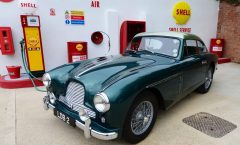
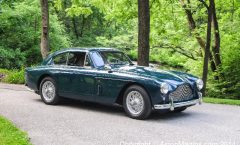
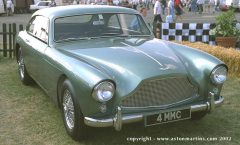
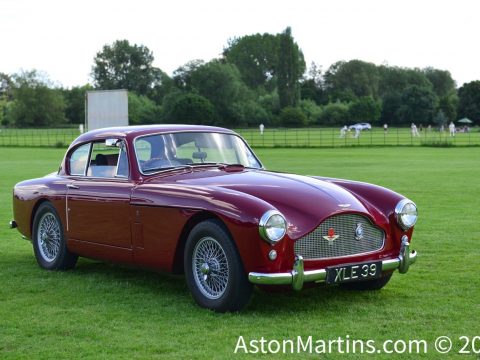
As the car started to look a little dated, the design was considerably freshened with the arrival of the DB Mark III, (the 2/4 bit was dropped) in 1957. The newly shaped grille was obviously influenced by the DB3S sports/race car. As well as the fixedhead 2+2, the Mark III continued to be available as a drophead coupe and eventually a rare fixedhead coupe too.
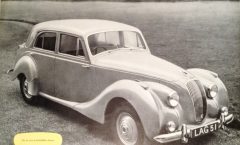
A significant number of Aston Martins from the 1950’s received coachwork from specialist coachbuilders. These elusive cars are often unique very difficult to track down yet there are photographs of most on the site.
The DB2 had started out as a pure 2-seater sportscar which through time was modified into the finest GT of the era. Each Feltham car competed head on with the XK120/140/150 series from Jaguar, albeit with a higher price tag and greater exclusivity. Both the Atom derived chassis and fine 6 cylinder engine had served AML well. Production of road cars at Feltham was wound down and everything gradually moved to Newport Pagnell in Buckinghamshire during the late 1950’s early 1960’s. The finest GT cars of the 1950’s were replaced by the finest GT car of the 1960s – the Italian styled DB4.
For owners of Feltham built Aston Martin cars, there is a club especially that caters for your needs. Aston Martin Feltham Club